

Updated July 2026
Dog moulting season UK: when it happens and what actually helps
UK dogs moult heaviest in spring, roughly March to June, as the winter coat drops out, and again in autumn, September to November, when the summer coat makes way for a thicker one. Centrally heated homes blur the pattern, so many dogs also shed lightly all year round. Daily brushing and a de-shedding groom at the start of each peak keep most of the hair off your floors.
There comes a point every spring, and again every autumn, when the hoover starts to feel like a part-time job. Dog hair on the sofa, on your clothes, drifting across the kitchen floor in little tumbleweeds. Moulting is one of the most normal things a dog does, but the amount can still catch you off guard, and it is not always obvious what is seasonal and what needs looking at. Here is how moulting season works in the UK, why some dogs shed so much more than others, and what actually cuts down the hair.
When is dog moulting season in the UK?
UK dogs have two proper moulting seasons. The big one runs through spring, roughly March to June, when the thick winter coat comes out to make way for a lighter summer one. The second runs through autumn, September to November, when the summer coat drops so a denser winter coat can grow in. Spring is usually the heavier of the two, which is why April and May are peak hair-everywhere months in most households.
The trigger is daylight as much as temperature. As the days lengthen or shorten, a dog's body gets the signal to swap coats, which is why the moult arrives every year whether the weather cooperates or not.
Central heating complicates things. A dog that lives indoors in a warm house never gets a strong seasonal signal, so plenty of UK pets shed lightly all year round with two noticeable surges on top. If you are reading this in July with a hoover in one hand, you have probably got a late spring moulter or a double-coated breed thinning out for summer, and both are normal.
Why is my dog moulting so much?
Nine times out of ten, heavy moulting is just the season doing its job. A few other everyday things turn the volume up:
- The breed. Double-coated dogs such as Labradors, German Shepherds and Huskies drop startling amounts of undercoat twice a year. It can come out in handfuls for weeks and still be completely normal.
- Hormones. Females often blow their coat after a season, and mums shed heavily a few months after having pups. Things settle once the hormones do.
- Puppy coat change. Somewhere between six and twelve months the soft puppy fluff comes out and the adult coat grows in. It is often a scruffy few weeks.
- Warm houses. Constant indoor warmth keeps the coat cycle ticking over all year, so the hair never entirely stops.
- Stress. A house move, a new baby or even a vet visit can trigger a short burst of shedding. It passes once the dog relaxes.
What you are looking for is hair coming out evenly all over, with healthy skin underneath. Even coat loss is a moult. Patchy loss is something else, and there is more on that further down.
Which dogs moult the most?
Labradors surprise people. Short hair, yes, but they are among the heaviest moulters in the country, and those short stiff hairs weave into fabric like velcro. German Shepherds shed so reliably that groomers nickname them German Shedders. Huskies, Malamutes, Golden Retrievers, Corgis and Border Collies all carry thick double coats that come out in clouds twice a year, and Pugs shed far more than their size suggests.
At the other end, Poodles, Bichons, Schnauzers and most Poodle crosses hold on to their dead hair rather than dropping it. That keeps your carpet cleaner, but the hair has to go somewhere, so it matts into the coat instead. A Cockapoo that never sees a brush ends up in more trouble than a moulting Labrador, just quieter about it.
There is no truly non-moulting dog. Every coat replaces itself. The difference is whether the old hair lands on your floor or stays tangled in the coat waiting for a groomer.
How to stop a dog moulting so much
Straight answer: you cannot stop a healthy dog moulting, and nothing you can buy will. What you can control is where the hair ends up. Ten minutes with a brush puts it in the bin. Ten minutes of ignoring it puts it on the sofa.
- Brush daily during the spring and autumn peaks. A slicker brush suits most coats, but a double coat needs an undercoat rake that reaches the woolly layer underneath, because a surface brush just polishes the top.
- Bath and dry properly. A warm bath loosens dead coat, and drying with decent airflow lifts out far more than brushing alone. This is most of what a professional de-shed is.
- Feed the coat. Hair is mostly protein, so a food with decent protein and omega-3, or a fish oil supplement, grows a coat that holds on rather than snapping and dropping. Give any diet change six to eight weeks to show.
- Keep up with flea treatment. Flea itching makes dogs scratch out far more coat than the moult ever would.
One thing not to do: never shave a double-coated breed to beat the moult. The undercoat grows back faster than the guard hairs, the coat can come back patchy and woolly, and the dog loses its built-in insulation against both cold and sun.
The UK moulting calendar, month by month
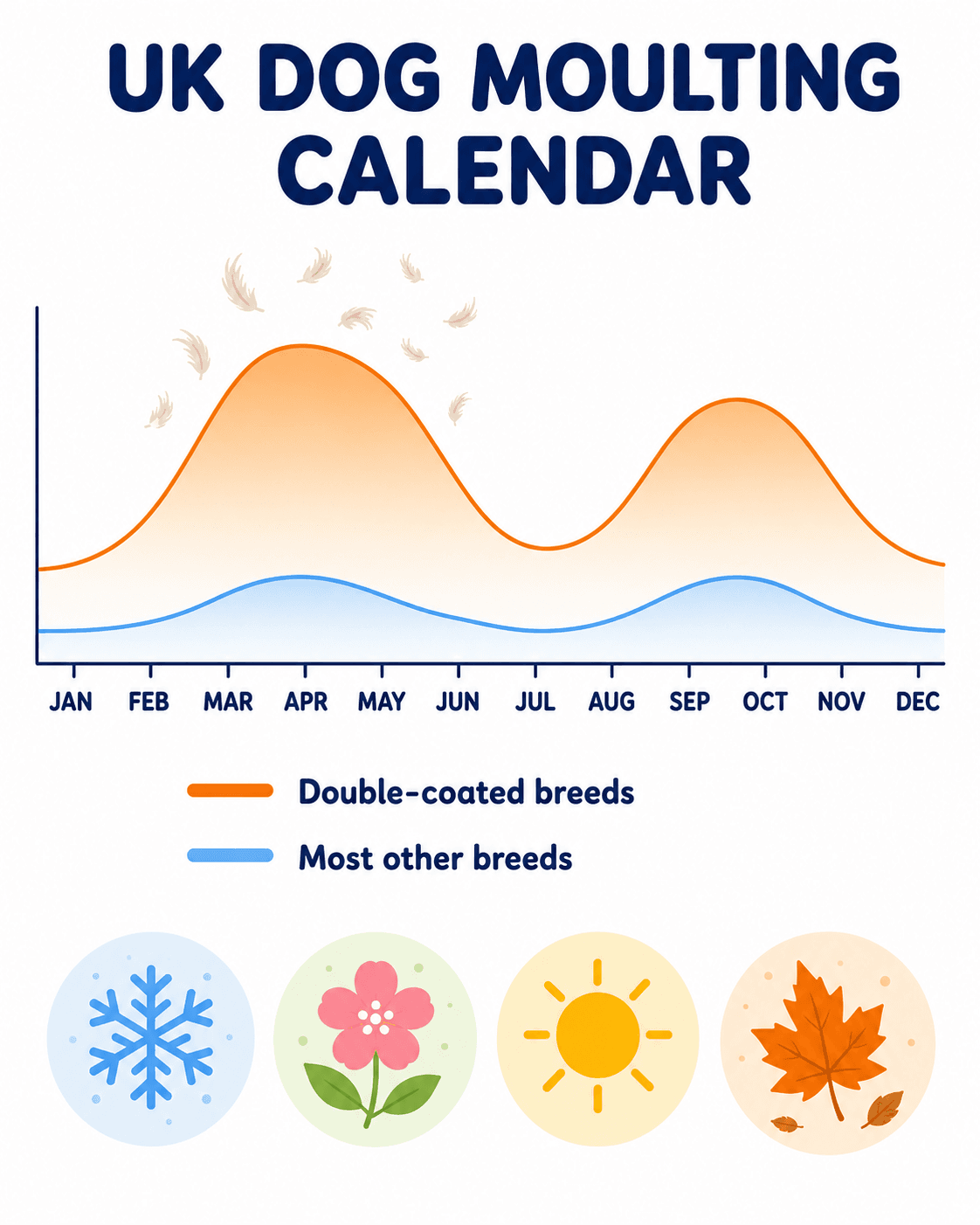
Here is the shape of a typical year for a UK dog. Individual dogs run early or late, and indoor living smooths the whole curve out, but the pattern holds for most.
- January to February: quiet. Light background shedding, mostly from indoor heat.
- March to June: the big spring moult. The winter coat comes out, heaviest around April and May. Double-coated breeds can shed for the full stretch.
- July to August: the tail end. Late moulters finish up and coats sit at their thinnest. Sudden heavy loss now is worth a closer look.
- September to November: the autumn moult. The summer coat drops and a thicker winter one grows in. Shorter and less dramatic than spring.
- December: quiet again, give or take what the central heating stirs up.
When moulting is not normal
A moult is even, and the skin under it looks healthy. Book a vet appointment rather than a groom if you spot any of these:
- Bald patches or thinning that shows skin
- Red, flaky, greasy or dark-stained skin
- Constant scratching, licking or chewing at one spot
- Hair coming out in clumps with dandruff or scabs attached
- A dull, dry coat along with low energy or weight change
The common culprits are fleas, allergies and mites, and more rarely hormone problems such as an underactive thyroid. All are treatable, and all are cheaper to sort early. The rule of thumb: coat loss that follows the calendar is a moult, coat loss that follows no pattern gets a vet's opinion.
What a professional de-shed actually does
A de-shedding treatment is the fast-forward version of everything above: a warm bath with conditioner to loosen the dead undercoat, a high-velocity dry that blows out hair a brush would take weeks to reach, then a thorough rake-through. One session can strip out most of the loose coat in an hour or so, which during the spring moult feels close to magic.
A mobile groomer does the whole job on your driveway, so the hair blizzard happens in their van rather than your bathroom. Two sessions a year, booked at the start of the spring and autumn moults, keep the worst of it off your floors. You can read more about de-shedding treatments or find a mobile dog groomer near you, from Greater London to Merseyside.
Frequently asked questions
Is it dog moulting or malting?
Moulting is the correct spelling for a dog losing its coat; malting is what happens to barley in a brewery. Plenty of people search for dog malting and everyone knows what they mean, but if you are writing to a groomer or a vet, moulting is the word.
How long does dog moulting season last?
A seasonal moult typically lasts two to four weeks for most breeds, though heavy double-coated dogs can shed hard for six weeks or more. Daily brushing genuinely shortens it by clearing the dead coat faster.
When do dogs shed the most?
Spring is the heaviest shedding period for UK dogs, with April and May usually the peak weeks. The autumn moult from September to November is the second surge, shorter and lighter for most breeds.
Why is my female dog shedding so much?
Hormones, usually. Unspayed females often drop a lot of coat after a season, and mums shed heavily around three months after having pups. It looks alarming but settles on its own; if it carries on past a couple of months, ask your vet.
Do dogs itch when they moult?
A bit of extra scratching is normal while dead hair works loose. Constant scratching, broken skin or biting at one spot is not moulting, and fleas are the first thing to rule out.
Do dogs moult in winter?
Lightly, yes. Central heating keeps indoor dogs shedding at a low level all year. A heavy, sudden moult in the middle of winter is unusual and worth a vet check if there is no obvious cause.
Should I shave my dog to stop the moulting?
No, especially not a double-coated breed like a Husky, German Shepherd or Golden Retriever. Shaving does not stop the shedding, it just makes the hairs shorter, and the coat can grow back patchy while the dog loses its insulation. A proper de-shed removes the loose undercoat without touching the guard hairs.
Do dogs shed more as they get older?
Coats change with age and some older dogs do shed more, often because grooming themselves gets harder. Gradual change is normal. A sudden heavy loss in an older dog is a reason to see the vet, as thyroid and other treatable conditions become more common with age.
Find a mobile dog groomer near you
Compare trusted mobile dog groomers in your area by service and coverage.
Find groomers